

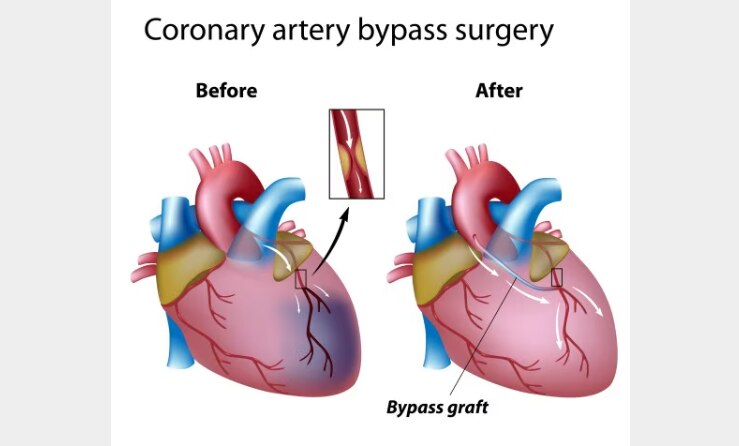
A blocked artery on an angiogram does not automatically mean you need bypass surgery. By the end, you will know which coronary disease patterns favour bypass, how doctors confirm that a narrowing is reducing blood flow, and how a heart team compares surgery with angioplasty and stenting.
Key takeaways
- An angiogram percentage alone does not decide whether bypass surgery is needed.
- Left-main disease, complex multivessel disease and diabetes can favour bypass.
- Emergency bypass decisions differ from planned treatment after stabilisation.
- A heart team compares bypass, angioplasty and medication for your anatomy and risks.
Which coronary disease patterns are bypass surgery indications?
Bypass surgery indications depend on the coronary pattern and its likely benefit, not an angiogram alone. For anyone asking when is bypass surgery for recommended in Nashik, there is no single blockage percentage or age threshold.
In stable disease, doctors consider revascularisation when medicines fail to control troublesome angina or when the anatomy suggests a prognosis benefit. A stress-test abnormality or visible narrowing does not automatically make surgery necessary.
Doctors weigh:
- Symptoms and their effect on daily activity
- Objective evidence that blood flow is reduced
- Left-ventricular pumping function and ejection fraction
- The number, location and complexity of diseased arteries
- Diabetes, kidney disease, frailty and operative risk
| Pattern | Why bypass becomes a serious consideration | What still matters |
|---|---|---|
| Significant left-main disease | It supplies much of the heart muscle, so restoring flow can improve prognosis | Anatomy, graftable vessels and surgical risk |
| Three-vessel disease | Several major arteries are affected, making durable complete treatment important | Symptoms, heart function and comparison with PCI |
| Proximal left anterior descending disease | This location supplies a large area of the left ventricle | Overall disease pattern, not the percentage alone |
| Severe disease with weak left-ventricular function | Selected patients with ischaemic cardiomyopathy may gain survival and symptom benefits | Viability, coronary targets and the cause of weakness |
| Diabetes with multivessel disease involving the LAD | CABG often provides better long-term outcomes than stenting in suitable surgical candidates | Diabetes control, kidney function and operative risk |
How do doctors decide whether a blockage is serious enough for bypass?
A narrowed artery on an angiogram does not automatically justify bypass surgery for blocked arteries. Coronary angiography shows where a blockage sits and whether its shape is long, irregular, calcified or at a branch, but an intermediate narrowing may not restrict blood flow enough to cause symptoms.
Doctors clarify the blockage’s significance with:
- CT coronary angiography, which assesses coronary anatomy without an invasive catheter in selected patients.
- A pressure wire, which measures fractional flow reserve (FFR); an FFR of 0.80 or less commonly supports revascularisation when the narrowing’s effect is uncertain.
- Instantaneous wave-free ratio (iFR); a result of 0.89 or less provides similar functional evidence without giving a pressure-wire drug response.
- Intravascular ultrasound (IVUS), which measures the artery from inside and examines plaque, calcium and left-main coronary lesions.
The final decision combines these results with the chest-pain pattern, breathlessness, stress-test changes, exercise capacity and left-ventricular ejection fraction. A lesion that reduces blood flow and matches the patient’s symptoms carries more weight than a narrowing found by chance.
Conversely, bypass may not improve symptoms caused by another condition when the artery is anatomically narrow but blood flow remains adequate. Doctors therefore assess both the blockage’s structure and its functional effect before recommending surgery.
Who needs heart bypass surgery instead of angioplasty and stenting?
Several major vessels, long or diffuse disease, heavy calcium, or blockages at branch points often favour coronary artery bypass grafting (CABG) over angioplasty and stenting (PCI). These features make it harder for a stent to fully open the artery or remain effective, increasing the chance of recurrent narrowing or another procedure.
| Option | Why it may be chosen | Main limitation |
|---|---|---|
| CABG | Bypasses complex disease and can provide a more durable result in selected multivessel cases | Requires open-heart surgery, usable target arteries and suitable conduits |
| PCI | Treats a suitable short blockage with less immediate recovery time | Long, calcified, diffuse or bifurcation lesions can have a higher repeat-treatment risk |
Diabetes with multivessel disease involving the left anterior descending artery often shifts the balance toward CABG when surgical risk is acceptable. Doctors also weigh kidney disease, lung disease, frailty, anaemia, previous stroke, heart function, recovery time, expected repeat procedures and your preference.
For anyone asking who needs heart bypass surgery, the answer depends on that complete risk-benefit comparison, not a vessel count.
A high-risk angiogram does not automatically make bypass possible. The surgeon needs graftable target vessels and conduits such as an internal mammary artery or vein; small, chronically blocked or diffusely diseased arteries may prevent complete revascularisation.
A Heart Team should review these details before coronary bypass surgery in Nashik, especially when medicines or selected PCI could be safer.
When is bypass urgent, and when is it not the first choice?
In an acute heart attack, urgent angioplasty is normally preferred when it can restore blood flow promptly. Emergency or urgent bypass surgery for blocked arteries is considered when angioplasty fails, cannot reach or treat the blockage, cannot restore flow, or ongoing ischaemia or a mechanical complication requires surgery.
| Situation | Usual approach | Why |
|---|---|---|
| Acute heart attack with treatable blockage | Urgent angioplasty | It restores blood flow faster than open-heart surgery when the artery is reachable. |
| Failed or impossible angioplasty | Emergency or urgent bypass | Surgery may be the only way to restore flow, especially with ongoing ischaemia or a mechanical complication. |
| Stable disease after outpatient testing | Planned CABG or PCI comparison | Doctors can stabilise medical conditions, complete imaging and weigh durability against recovery and procedural risk. |
| One short blockage suitable for angioplasty | Usually PCI and stenting | Opening one accessible lesion avoids the larger burden of surgery. |
| Small, diffuse or chronically occluded vessels | Medicines or selected PCI | The surgeon may lack a usable target for a graft, making complete revascularisation difficult. |
| Severe illness or non-obstructive symptoms | Treat the underlying problem | Open-heart surgery may be unsafe, or bypass will not relieve symptoms caused by another condition. |
A dramatic angiogram does not guarantee that bypass is possible. CABG needs graftable coronary targets and suitable conduits, such as an internal mammary artery or vein. There is no Nashik-specific blockage percentage or age threshold: symptoms, reduced blood flow, heart function, anatomy and medical risk determine the choice.
How does a heart team decide on bypass surgery for a patient in Nashik?
The question when is bypass surgery for recommended in Nashik cannot be answered by a blockage percentage or age alone. The decision depends on anatomy, symptoms, blood-flow evidence, heart function and operative risk.
1. An interventional cardiologist, clinical cardiologist and cardiac surgeon review the angiogram or CT images, stress-test or other functional results, symptoms and left-ventricular ejection fraction.
2. They check diabetes, kidney and lung disease, anaemia, frailty, previous stroke and other conditions that affect surgical risk, recovery and the safety of contrast or anaesthesia.
3. The team decides whether treatment is urgent, whether medicines can stabilise you, or whether further imaging or testing is needed. Ongoing chest pain, unstable blood flow or failed angioplasty changes the timetable.
4. For planned coronary bypass surgery in Nashik, they compare CABG with PCI by weighing durable benefit, recovery burden, graftable arteries, repeat-procedure risk and your preference.
Dr Sheetalkumar Hiran at Nine Pearl Hospital can help organise this specialist assessment, review reports and identify when referral to a cardiac-surgery service is needed.
Bypass does not remove atherosclerosis. After surgery, continue prescribed antiplatelet treatment, stop smoking, control blood pressure and diabetes, take lipid-lowering medicine, exercise safely and complete cardiac rehabilitation.
Chest pressure lasting more than a few minutes, breathlessness, cold sweating, fainting, or pain spreading to the arm, jaw, back or shoulder requires emergency care, not a routine consultation.
Frequently asked questions
Which coronary disease patterns are bypass surgery indications?
Doctors consider bypass for patterns such as significant left-main disease, complex multivessel disease, or disease affecting important coronary branches when surgery offers better long-term blood-flow improvement than stenting.
How do doctors decide whether a blockage is serious enough for bypass?
They combine angiogram findings with symptoms, heart function, the affected artery, blood-flow measurements, diabetes and other health risks. A percentage alone does not determine the treatment.
Who needs heart bypass surgery instead of angioplasty and stenting?
Bypass can be preferred when blockages are widespread, heavily calcified, difficult to reach with a stent, involve the left main artery, or occur with diabetes and complex multivessel disease.
When is bypass urgent, and when is it not the first choice?
Emergency assessment is needed for ongoing heart attack symptoms or unstable coronary disease. Planned bypass is considered after stabilisation when surgery offers a stronger benefit than stenting or medication.
How does a heart team decide on bypass surgery for a patient in Nashik?
The heart team reviews symptoms, ECG and imaging, coronary anatomy, heart-pumping function, kidney health, diabetes, surgical risk and personal priorities before recommending bypass, stenting or medical treatment.